April 27, 2005
Carr criticizes Liberals for backing gas-fired power plant
Glenn Bohn, Vancouver Sun, 27 Apr 2005
Robert Barron, Nanaimo Daily News, 27 Apr 2005
Carr criticizes Liberals for backing gas-fired power plant
Glenn Bohn
Vancouver Sun
27-Apr-2005
NANAIMO -- Green party leader Adriane Carr said Tuesday that if the Liberal government was committed to environmental protection, it would be reducing B.C.'s use of fossil fuels, not supporting a natural-gas-fired power plant at Duke Point near Nanaimo.
Carr said BC Hydro, a provincial Crown corporation, should be getting new electricity for Vancouver Island by supporting wind, tidal and other alternative sources of energy -- not a fossil-fuel-burning project that puts more greenhouse gases and local pollutants into the atmosphere.
"You cannot be committed to clean air and be driving the fossil fuel energy path, as the Liberals are doing," Carr said, speaking near the proposed site of the 252-megawatt power plant.
"We have a global commitment, the Kyoto commitment, to reduce our use of fossil fuels."
A Green party document released last week proposes energy conservation tax credits of about $5,000 apiece for 10,000 homes, for an estimated cost of $50 million. The Greens also want to set aside $100 million for renewable energy subsidies.
"The biggest cost saving is in energy conservation," Carr said.
She said B.C. shouldn't be using a precious and increasingly expensive resource -- natural gas -- to generate electricity near Nanaimo.
"The pollution would drift over to Greater Vancouver, which already has its pollution problems," she added.
The Duke Point power project, which was initially supported by the former New Democratic Party government, was approved this February by the B.C. Utilities Commission. Hydro's top executives have said the gas-fired power plant is the best way to provide customers on the Island with the electricity needed or else face a power shortfall in 2007.
But Philip Stone, the Green's candidate for the North Island riding, noted an already-approved 450-megawatt wind farm on the northern tip of Vancouver Island is expected to generate enough power for 135,000 homes. He complained that BC Hydro hasn't committed to buying that wind-generated electricity and the power will be exported to the U.S., through a submarine cable that crosses the Strait of Juan de Fuca.
"Instead, we're selling ourselves into fossil fuel slavery," Stone said.
Carr, whose party won about 12 per cent of the popular vote in 2001, said the Green party would not allow the Duke Point power project to go ahead if it formed the next B.C. government.
When a reporter reminded Carr she has already acknowledged her party won't win the election, Carr chuckled and said "that's true."
But, she said, "Elected Greens can play an incredible role in the legislature."
She pointed to the effect of two NDP MLAs in the last legislature, Jenny Kwan and Joy MacPhail.
"We all have to acknowledge that even two feisty women in the last sea of Liberals played a big role, in terms of raising issues," she said.
B.C. Green Party leader Carr takes shot at Duke Point plant
Robert Barron
The Daily News (Nanaimo)
27-Apr-2005
The burning of fossil fuels for energy, vote-splitting and the dangers of fish farms were just a few of the topics discussed by Adriane Carr, the Green Party's provincial leader, at Duke Point Tuesday.
Flanked by two local Green candidates in the provincial election, Nanaimo's Doug Catley and North Island's Philip Stone, Carr said if she were elected premier, she would consider cancelling the $280-million Duke Point power plant project.
"If the decision was made that building the power plant is wrong and the public indicated they were interested in moving to different ways to meet our energy needs, then a Green government would work out a deal to get out of the plant contracts," she said, standing in front of the entrance of the proposed plant.
"We need to move away from the entrenched use of fossil fuels as we're moving entirely in a different direction from our commitments under the Kyoto Accord."
Carr said the province has to move to alternative, clean and renewable energy sources that will cost less in the long run.
"The province has one of the greatest potential for wind power in the world and there's a proposal for a wind energy farm in North Island," she said.
"However, BC Hydro has never given wind companies a fair shake by offering them the same prices for their power as they've given the Duke Point operators, so the wind farm is looking to sell its power in the U.S."
VOTE-SPLITTING
Asked if she felt her party would split the votes between the NDP and Greens, ensuring a Liberal win in the election, Carr said votes for the Green Party "come from across the political spectrum."
"During the last election, people were leaving the NDP in droves so the party shouldn't be blaming us for their loss," she said,
"People are coming to us from both the Liberal and NDP camps, and about 30% who voted for us last time said they wouldn't have voted at all if we weren't in the running."
Catley said he's "insulted" by the notion the Green Party would be splitting votes with the NDP.
"This is a democratic process which allows people to stand up for what they believe in," he said.
"I find it incredible that we'd be accused of vote-splitting as it's an insult to the process to suggest that diversity of thought is not recognized. The Green Party is neither left nor right, but global."
FISH FARMS
Carr said salmon farms are not healthy for the wild salmon that swim nearby.
"I want to place a cap on current fish farms and replace the industry with a restoration of wild fisheries," she said.
"Wild fisheries provide more jobs and are more sustainable than fish farms."
April 26, 2005
Duke Point Power opponents continue Appeals Court fight
GSX Concerned Citizens Coalition
304 - 733 Johnson Street, Victoria, BC, V8W 3C7
Telephone (250) 381-4463
Email: thackney@island.net Website: www.sqwalk.com
For Immediate Release: April 26, 2005
Duke Point Power opponents continue Appeals Court fight
Victoria – The GSX Concerned Citizens Coalition (GSXCCC), the BC Sustainable Energy Association (BCSEA) and the Society Promoting Environmental Conservation (SPEC) will continue their BC Court of Appeal challenge to the BC Utilities Commission decision that approved BC Hydro’s plan to buy power from the Duke Point Power’s gas-fired generation plant.
“We want our day in court,” said Tom Hackney, President of the GSXCCC. “We are convinced there is an apprehension of bias in the Utilities Commission decision; and the evidence shows the Duke Point power plant is unnecessary, costly and contrary to our Kyoto commitment to reduce greenhouse gases.”
“We carefully reviewed the reasons Judge Thackray gave for dismissing our appeal application,” said Hackney “We are not satisfied that he grasped the facts of the case or understood our strong reasons for claiming an apprehension of bias. This goes to the heart of people’s ability to trust in the fairness of the Utilities Commission’s decisions on matters affecting Hydro rates and the public interest.”
On 28 February, the GSXCCC, BCSEA and SPEC applied to the Court of Appeal for leave to appeal the Utilities Commission’s 17 February decision, which approved BC Hydro’s electricity purchase agreement with Duke Point Power LP to buy the output from a 252 MW plant that is scheduled to be built this year at Duke Point.
GSXCCC, et al claim there is a reasonable apprehension of bias that the Commission panel reviewing the purchase agreement had made up its mind in favour of the power plant before having heard all the evidence and arguments. GSXCCC, et al also claim the Commission panel conducted itself improperly during an in camera session and exceeded its jurisdiction in disregarding potential cost liability of using natural gas – a known source of greenhouse gases – in the power plant. The Joint Industry Electricity Steering Committee, representing industrial users of electricity, also filed for an appeal, on similar grounds.
On 6 April, GSXCCC, et al and JIESC argued their applications for leave to appeal before Judge Thackray of the Court of Appeal. On 12 April, Thackray dismissed both applications, issuing reasons on 20 April.
The GSXCCC, et al will shortly file documents to ask a three-judge panel to review and reconsider Judge Thackray’s dismissal.
For more information, call Tom Hackney at (250) 381-4463.
Download the GSXCCC News Release
April 25, 2005
BCUC awards $460,000 in participant funding
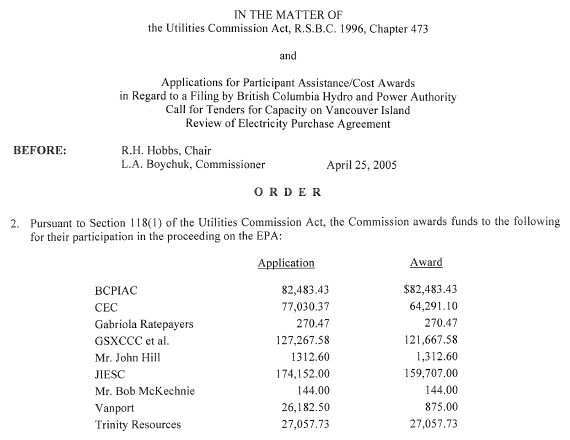
Download letter to GSX Concerned Citizens Coalition from BC Utilities Commission
Download participant funding application from GSX Concerned Citizens Coalition to BC Utilities Commission
April 23, 2005
Power plant foes weighing options
John Kimantas
Nanaimo News Bulletin
Apr 23 2005
Groups behind a court challenge to derail the Duke Point natural gas power plant are assessing their options in advance of the next stage of the appeal process.
Tom Hackney of the GSX Concerned Citizens Coalition said a decision is likely early next week on whether to proceed with the legal challenge in the B.C. Court of Appeal.
The stall in the plans comes courtesy of the release Wednesday of the B.C. Court of Appeal's reasons for decision.
The GSXCCC is one of the intervenors seeking for leave to appeal the B.C. Utilities Commission decision to grant B.C. Hydro a certificate of public convenience for the Duke Point plant.
The certificate is the last official hurdle before the power plant can proceed.
The reasons for judgment pose a serious blow for the Duke Point plant critics.
Justice Allan Thackray allowed few grey areas in his assessment of the appeal bid.
"In my opinion there is nothing in the submission of the applicants that would ground a successful appeal of the decision of the commission on the basis of either unduly limiting the scope of the hearing or of its use of and interpretation of the issue of public interest," Thackray wrote.
Hackney said his group will review the reasons for judgment.
"We'll be looking them over and assessing our options," he said.
Two days are already set aside May 2-3 in the B.C. Court of Appeal to hear the matter.
Jeff Myers, president of Pristine Power, the group that will build and own the power plant at Duke Point, celebrated the judge's decision.
"Justice Thackray's reasons for decision provide confirmation that the BCUC hearing process was fair and appropriate," he said in a press release.
Meanwhile, B.C. Hydro is taking a wait-and-see approach.
Hydro spokeswoman Elisha Moreno said the Crown corporation won't be proceeding with the power plant until the appeal process has run its full course.
She said the agreement with Pristine Power has already been signed.
The air we breathe
John Kimantas
Nanaimo News Bulletin
Apr 23 2005
It's a sunny week for a workshop at Karen Sato's home in rural Cedar, and cars of the participants line the front lawn of the Cedar Heights Crescent home.
The topic for Karen Sato's class is consegrity - wellness support - and Sato has chosen the Cedar location as her base for its quiet rural nature, one that fits in well with the workshop's theme.
On this unusually warm April afternoon, however, there's one fly in the ointment - a rotten egg-like smell of sulfur that for some reason seems to settle in pockets and valleys across the Cedar area in areas like one near Woobank Road.
For pollution, this area is likely only to see it become worse. With the construction of the Duke Point natural gas-fired electrical generation plant, this neighbourhood is essentially "ground zero" - the closest cluster of residential properties to the proposed power plant.
Cold start-ups will have the worst local effect. During these, the predicted highest concentrations of nitrous oxide and carbon dioxide emissions will be within 300 metres of the stack; the nearest residences are 700 metres away.
Experts say even the worst exposures won't be a health risk. In the closest area, once combined with emissions from Harmac, nitrous oxide levels are expected to reach 178 parts per million. That's below World Health Organization guidelines and less than half of what the Environmental Assessment Office refers to as "the federal government objective."
Sato, given her background, is particularly attuned to the energy of an area. Her initial reaction at the prospect of the plant was fear, she says.
But after a walk in the woods and seeing wildflowers blooming, however, she felt more confident that all will be well.
Her attitude in combatting the risk is philosophical.
"Adding more fear will generate more fear and then it will be that much more harmful," she says.
Most neighbours tend to share the same general lack of concern. In a conversation with three other families in the MacMillasn Road area - the closest residences to the Duke Point stack - none expressed concern. In fact, all three said they had not even followed the controversy.
One other person with no concerns about the construction of the Duke Point plant is the man with his nose closest to the city's air quality monitoring.
The monitoring equipment, a collection of unassuming electronic consoles, sits below air tubes in a climate-controlled but otherwise unremarkable office on the third floor of the Water, Land and Air Protection office on Labieux Road.
Warren McCormick, an air quality meteorologist, is charged with checking the
station several times a day.
The Nanaimo station is a minor one, checking ozone and sulphur dioxide levels.
The ozone is the feature associated with urban smog. Sulphur dioxide originates from fuels with sulphur in it, such as oil and gas.
Day after day the machines monitor the air, and day after day the readings come out the same: that Nanaimo's air quality is good.
There are exceptions. McCormick says one occurs in the spring when the ozone levels, due to global background levels or special weather events, put the ozone level slightly above the "good" and into the "fair" range.
The other time of concern is in the fall when the fine particulate matter level goes high.
McCormick notes that those readings coincide with open burning, especially when coupled with periods of clear skies and light winds.
Another air quality station monitors Harmac for particulate matter known as PM10, a harmful pollutant that can penetrate deep into the respiratory tract, affecting breathing.
Another measure taken at Harmac is for TRS, totally reduced sulphur, a sulphur compound that is reduced because it doesn't have oxygen.
TRS is the focus of emission control not because it's particularly harmful, but because all pollutants tend to be lessened when TRS levels are reduced. TRS is also responsible for the kraft mill smell associated with Harmac.
"It's the one people notice the most," McCormick said.
While the smell is an indication of pollutants, McCormick said the ability to smell TSR is no indication the level is dangerous.
"Some people can actually smell it at levels lower than our instruments can measure it," he said.
If figures show Nanaimo's air quality is good today - and enviable if you live in places like Chilliwack, where the province's air quality is at its worst - it's the future that is causing most distress.
Opposition is aimed squarely at large projects: the Duke Point power plant and the hog fuel burner at Coastland Wood Industries.
McCormick is one of the few in favour, a position earned through his inside knowledge of emissions.
He doesn't expect things to get worse.
"I think it will be barely measurable," he said.
It's a position mirrored by the Environmental Assessment Office. The office's 2002 assessment report on the Vancouver Island Generation Project - Duke Point - gives the plant a clean bill of health.
The key finding: that the proposed plant would not have a significant impact or even an incremental impact on air quality, with emissions well under established criteria.
It's a view not shared by its critics. And there are many. For the Environmental Assessment review process, the office received about 400 submissions. Only five were in favour.
Despite the outcry, the opponents have failed at every stage.
It's a split just about right down the middle: officials in agreement, and the general public opposed.
Next: How the two sides can be so far apart.
April 22, 2005
Environmental and financial consequences of Site C dam
Ruth-Ann Darnall
Vancouver Sun
22-Apr-2004
On April 8 in The Sun, David Black, chair of the B.C. Progress Board, presented his case for building Site C, a 900-megawatt hydro-electric dam on the Peace River in northeastern British Columbia. It sounded too good to be true. It probably is.
There is more to the Site C story, much of it found in recent BC Hydro documents and in the conclusions of the B.C. Utilities Commission when it considered the Site C project in the early 1980s.
BC Hydro estimates that the project would leave a footprint of 12,800 acres (5,125 hectares). Of this, 10,000 acres (3,940 hectares) is judged by both Hydro and the commission to be farmland of agricultural significance -- not the 500 hectares estimated by the B.C. Progress Board.
Much of this is Class 1 agricultural land, with Class 1 climate capability, an increasingly rare commodity in British Columbia. Not only would the acreage be lost, but any Class 1 land that remained would have to be downgraded to Class 2 because of climate change brought about by the impoundment. In the late 1970's, BC Hydro introduced a "passive land acquisition program," under which it acquired about 7,500 acres. The remainder of the titled land is held by private individuals.
The Progress Board dismissed the environmental consequences of Site C because "there are no salmon in the river." In fact, the unique wildlife values of the Peace Valley were recognized by the South Peace Land Resource Management Plan, which laid out the Peace Boudreau Protected Area on the south side of the Peace River. The valley provides crucial wintering and calving habitat for ungulates and is a critical nesting area for warblers and an important flyway for 70 species of birds and waterfowl.
So let us be clear: The environmental footprint of Site C is not inconsequential.
There are some things man cannot put into economic terms. The Peace Valley is one of them. Yet in these times, neither environmental consequences nor pristine beauty will be the basis upon which Site C will be judged; Site C will stand or fall on economic considerations.
British Columbians must hope that once again, the utilities commission will provide the acuity and vigilance needed to determine truly and fairly the full costs of this mega-project. Black maintains that the dam "can be 100 per-cent financed by pre-selling the power for export, resulting in little financial risk."
California is the market mentioned. Have British Columbians forgotten that California received $455 million worth of electricity from BC Hydro in 2001 that it has steadfastly refused to pay for? Having forgotten that they asked for help to keep the lights on, California accuses B.C. of somehow being at fault and overbilling them. Not only did the California companies refuse to pay, BC Hydro was forced to defend itself from attempts to sue for refunds.
Despite a ruling last year by the U.S. Federal Energy Regulatory Commission that BC Hydro had done nothing wrong, the bill remains unpaid. Is this the market into which British Columbians wish to entrust a "self-financed" $2.2-billion dollar investment? What have been the legal costs of defending BC Hydro and chasing that $455 million? The Progress Board opines that "financial returns can be guaranteed." Guaranteed by whom? In the end, any financial returns will be guaranteed by B.C. ratepayers.
Something that seems too good to be true usually is. Such is the scenario laid out by Black.
Make no mistake: Site C is not without environmental consequences, nor financial risk.
Ruth-Ann Darnall is chair of the Peace Valley Association, which was formed in 1975 to ensure the preservation of the Peace River Valley.
(No website; she lives in Fort St John)
April 20, 2005
BCCA reasons for decision
The reasons for judgment in the dismissal of the GSXCCC’s and JIESC’s respective applications for leave to appeal the BCUC’s approval of the Duke Point EPA are now on the BCCA website at www.courts.gov.bc.ca
April 19, 2005
How to Curb BC’s High Risk Hunger for Energy
Alan Durning
The Tyee
April 18, 2005

Spreading pipelines, vulnerable to sabotage, fuel our growing appetite.
Last year, one of the most surprising findings of a new regional index of progress called the Cascadia Scorecard was that -- of seven key trends -- British Columbia and the rest of the Pacific Northwest scored most poorly on energy efficiency.
Yes, despite Cascadians’ interest in renewable energy, clean energy, and hybrid cars, the average northwesterner consumes nearly as much highway fuels and nonindustrial electricity as a Texan. British Columbians are more energy efficient than folks from Washington, Oregon, or Idaho, but still consume relatively high levels of energy -- almost 50 percent more per person than Germans.
This year’s edition of the Cascadia Scorecard, released last month, confirmed the region’s poor performance on energy and added a surprise twist to the story -- as well as some good news.
Vulnerable to attack
The surprise is that not only does the region’s energy consumption remain high—despite high gas prices, British Columbians’ per-person energy use actually increased in 2004 -- but the region’s energy system is also highly insecure on an infrastructure level. Cacadia’s pipelines and powerlines are highly vulnerable to sabotage that, if realized, could seriously disrupt the regional economy.
British Columbia, for example, gets most of its oil from Alberta through the Trans-Mountain Pipeline, which crosses hundreds of miles of hinterlands before reaching the lower Fraser Valley. Like similar pipelines, the Trans-Mountain is almost impossible to secure against determined attackers. The region’s five natural gas pipelines are more explosive than oil pipelines, and—unlike oil—gas has no alternative mode of transport.
The good news is that there is a solution that pays for itself -- a clean-energy revolution that promises to make BC’s energy system secure, efficient, and more profitable. Strategies such as clean-car standards and innovative incentives for energy efficiency can bombproof the Pacific Northwest’s energy system, generate thousands of jobs, and help the region improve its “score” in energy efficiency.
Clean car ‘feebates’
In transportation, one of the most promising strategies is “clean cars,” the super-efficient, advanced-technology vehicles that British Columbia will get if Ottawa honors its Kyoto pledge and demands steep cuts in new-vehicle emissions. Clean cars are like a decentralized petroleum reserve. Their fuel tanks and those at filling stations hold several weeks’ supply -- a security buffer, should pipelines stop flowing.
The Canadian government and the big automakers recently signed an agreement to reduce emissions of greenhouse gases from new vehicles. With Canada firmly on board for clean-car standards, as well as seven states in the US, the auto industry will have a much greater incentive to design more fuel-efficient cars.
On the consumer side, the drive toward clean cars would be accelerated by a powerful efficiency incentive called feebates, which is getting traction in Canada. The basic idea is elegant in its simplicity: In the case of vehicles, cars that are more efficient than average come to the showroom carrying a rebate for their buyers. Those rebates are proportional to the efficiency of the vehicle, so superefficient vehicles come with whopping big rebates.
Conversely, cars and trucks that are less efficient than average, come with a fee -- a fee that grows with the vehicle’s inefficiency. The fees pay for the rebates each year, so it’s revenue neutral. Even better, feebates would have a “snowball” effect on efficiency because they are designed to continuously tug the entire car and truck market toward better fuel efficiency.
Correcting a market flaw
Economists like feebates because they correct a market flaw by making purchase prices a better reflection of the real costs of energy-inefficient products. Environmentalists like feebates because they put prices in line with Canada’s Kyoto commitment. Ottawa is considering implementing vehicle feebates as part of its 2005 budget, but they could be used for any energy-using product.
Similar energy savings are readily available not only in transportation, but also in buildings and industry. Energy efficiency can save energy less expensively than new sources can provide it, as BC Hydro’s ambitious PowerSmart plans make clear.
Investment in renewable energy can also add dramatically to the province’s energy security by diversifying and decentralizing energy sources. Western Canada is already benefiting economically from an emerging base of businesses that specializes in energy efficiency and renewables, green buildings, and alternative fuels. Ballard Power Systems of Burnaby leads the world in hydrogen fuel cells, which have potential for both transportation and distributed power generation.
A new ethanol
Another quick-maturing technology, which Canadian firm Iogen is pioneering, is cellulose ethanol, a fuel made from crop and forest residues and urban wastes that could be locally produced in rural British Columbia. Other areas with potential are passive-solar design, highly efficient woodstoves in nonmetro areas, and windpower.
Saving oil and natural gas through efficiency gains and investment in renewables would also generate profit by allowing BC to import less oil from Alberta and to export more of the natural gas it already extracts. All told, the province’s economy stands to gain up to a maximum of $10 million a day: up to $5 million by not importing as much oil and another $5 million by increasing exports of gas. Instead, the money will circulate locally, creating jobs and supporting BC businesses.
Such changes won’t appear magically. They will require leadership and the embrace of innovative new incentives detailed in Cascadia Scorecard 2005. But the payoff will be enormous: British Columbians keep home more of their energy money. They get an energy system that’s less vulnerable to sabotage. And future editions of the Cascadia Scorecard may start by lauding the region’s energy efficiency -- instead of lamenting its low score.
[Tomorrow: How BC sustainability stacks up against U.S. Northwest on health, economy, population, sprawl, forests, pollution and energy.]
Alan Durning is executive director of Northwest Environment Watch. The Cascadia Scorecard, launched in 2004, monitors seven key trends critical to the future of the Northwest, including health, economy, population, energy, sprawl, forests, and pollution. See sidebar, “Keeping Score,” for more information on the province performed in these trends. And for regular updates on the Scorecard, click to subscribe here.
The Tyee features online discussion on articles such as this one. Check it out. Join the discussion.
April 18, 2005
Dams Hit Dry Spell
Marc Lifsher
LA Times
April 17, 2005
A prolonged Northwest drought has cut water levels along the Columbia River, meaning less hydropower is available for export to the south. California's grid operators are worried.
In 1941, folk singer Woody Guthrie wrote a paean to the Columbia River's Grand Coulee Dam, enthusing that power generated by the New Deal monument "is turning our darkness to dawn." (Right click to download and save Woody Guthrie's classic Roll on Columbia)
But this summer, the Pacific Northwest's mightiest river could leave California in the dark. A stubborn drought has reduced water levels behind the Columbia's network of power-producing dams by a third, leaving less electricity available for export to the south.
And that prospect is making California's power grid operators nervous.
The Golden State historically has relied on Northwest hydropower to help keep the lights on and air conditioners humming during periods of peak summer demand, and this year will be no exception. California expects to import as much as 6,000 megawatts of Northwest power on the hottest summer days — enough to serve about 4.5 million typical homes.
For now, power officials in the Northwest, whose massive hydroelectric dams can produce more than 15,000 megawatts of electricity when running full bore, say they should be able to meet that need, even if they can spare the extra power for only a few hours at a time.
But if California is hit by a severe late-summer heat wave — statistically a 1-in-10 possibility — the state would have to seek emergency supplies of Northwest hydropower to avoid forcing utilities to cut service to some large customers, according to a forecast released last month by the California Energy Commission.
And if sweltering weather grips Southern California for an extended period, the Columbia Basin's parched watershed might not be up to the task.
"We've got a lot of turbines on the river, and we can probably run them for three hours without depleting much of the water behind the dams," said John Fazio, a systems analyst with the Northwest Power and Conservation Council, which coordinates electricity supplies in Oregon, Washington, Idaho and Montana. "But we can't keep it up for a week."
Even normal weather conditions could severely tax California's electricity grid this summer, according to a recent forecast by the California Independent System Operator, which runs a 25,000-mile transmission grid that covers most of the state — although major service areas such as the cities of Los Angeles and Sacramento are outside its jurisdiction.
Power shortfalls could occur despite large-scale imports from the Northwest, Arizona and across the West, Cal-ISO warned, pointedly noting that "in severe drought conditions, neighboring regions' water levels may be too low" to provide the spare electrons California would need at times of peak demand. That happened as recently as 2001, when drought conditions in the Northwest cut hydropower exports to California, contributing to the energy crisis.
"Things will be tight," conceded Jim Detmers, Cal-ISO's acting chief operating officer.
California and the Pacific Northwest have a long history of mutual power dependence, dating to President Franklin D. Roosevelt's creation of the Bonneville Power Administration in 1937.
Roosevelt created the BPA to operate the massive Bonneville and Grand Coulee dams, as well as other hydroelectric dams on the Columbia River and its tributaries. The president envisioned the BPA as a kind of Western version of the Tennessee Valley Authority, the government corporation that dammed rivers and delivered electricity and industry to the rural South during the Depression.
The Northwest project, called a "socialist boondoggle" by critics, struggled for years to win public support. In 1941, the BPA paid folk singer Guthrie $10 a song to write 26 anthems, ballads and blues — including "Talkin' Columbia" — that praised the mammoth dams and the men and women who built them.
During the next seven decades, the BPA, a self-financing federal government agency, has marketed power from 31 dams and other sources. The agency has been an engine of growth in what had been rural areas of Oregon and Washington, providing below-market-price power to aircraft manufacturers, aluminum smelters, computer makers and farmers.
"The Roosevelt plan was to industrialize the area," said Robert McCullough, an energy consultant in Portland, Ore. "He built the string of dams along the Columbia into the largest integrated hydropower project in the world."
Since its creation in the late 1930s, the Northwest hydro system has been a reliable energy trading partner, sending electricity south on two massive transmission lines to help meet California's summer needs and getting power back to heat homes and businesses during the winter. During recent summers, imports from the Northwest have supplied about 14% of California's electricity needs.
But this year's drought may strain that relationship. Conditions in Oregon and Washington are the driest in almost 30 years. Stream flows are at record lows, increasing the likelihood that farmers will have less water for irrigation and threatening environmental protections for fish and wildlife. Forest managers, meanwhile, are preparing for a difficult fire season.
Despite the Columbia's low levels, the Western hydroelectric power forecast is not uniformly grim.
Snow levels in all parts of California's Sierra Nevada are near records as the persistent high-pressure system that kept Oregon and Washington dry shoved the moisture-bearing jet stream southward. The state Department of Water Resources this month reported snow levels at 37% above normal, providing ample melt to power turbines in California's network of dams.
But some experts worry that even that unexpected bounty may not compensate for the sparse rainfall to the north.
Indeed, California's plan to import 6,000 megawatts from the Northwest and at least an additional 3,000 megawatts from nearby Southwestern states this summer amounts to "wishful thinking," said Gary Ackerman, executive director of the Western Power Trading Forum, a trade group that represents electricity generators and wholesalers.
"When you've got hot weather in Phoenix, Portland and California at the same time, those Northwest megawatts are not going to show up in California," Ackerman said. "They'll be taking care of the air-conditioning load up there."
In addition, Cal-ISO — which tries to ensure that electricity gets delivered where and when it is needed in California — is not allowed to sign long-term contracts with Northwest generators, leaving that job to the utility companies. In a power emergency, the agency might have to take a back seat to other big users, such as industries and cities in the Northwest, that have already lined up supplies of scarce hydropower.
And even if the power is available, it may not come cheaply. If blackouts loom and California needs to buy emergency electricity, dispatchers at Cal-ISO would have to scramble to buy whatever power is available "out of market." Unlike the spot market, where power prices are capped at $250 a megawatt hour, out-of-market power costs whatever the seller decides to charge.
No one is predicting the kind of price increases that occurred in 2000-01, when power shortages were exacerbated by outright market manipulation by energy traders. But tight market conditions that drive up the cost of Columbia River hydropower also push up the price of natural gas burned in modern turbine power plants — making even California's home-grown electrons more expensive.
Waiting until the last minute to buy Northwest power carries other risks. It means the state has little or no margin for error if transmission lines become congested or a forest fire — more likely now in the drought-stricken region — causes line outages, McCullough said.
It doesn't help that the Bonneville Power Administration is charged by federal law with trying to balance regional energy needs with the protection of dozens of species of endangered fish and wildfowl. Significantly increasing water flows through BPA dams to generate more power could kill huge numbers of salmon — and could even be forbidden by federal wildlife officials under certain circumstances.
During the energy crisis, traders for the disgraced Enron Corp., who were manipulating the market to boost profit, joked about how dams in the Northwest were killing fish to generate extra power for California.
Northwest power coordinators could say no if "California calls up in a crisis and asks to wipe out a few million salmon," McCullough said. "Should you schedule flows to maximize survival of salmon or set them aside to cover … California?"
If California suffers an energy squeeze this summer, it is more likely to strike in the southern part of the state, where electricity supplies are particularly vulnerable to shortages, energy officials said.
During the last few years, power consumption has grown faster in the south than in Northern California, and more new power plants have been built in the north.
Meanwhile, a growing economy is boosting state electricity consumption 4% a year, putting further pressure on old power plants and congested transmission networks.
Clearly concerned about the potential for trouble, the administration of Gov. Arnold Schwarzenegger has made heading off blackouts this summer and next a top priority. The 2000-01 energy crisis and then-Gov. Gray Davis' role in it contributed substantially to Schwarzenegger's victory in the October 2003 recall election.
While state officials fret, California's investor-owned utilities remain sanguine — at least publicly — about the power prospects for the coming summer.
Southern California Edison Co., the utility unit of Rosemead-based Edison International that serves much of Southern California outside the cities of Los Angeles and San Diego, told a legislative committee this month that it did not expect to import significant amounts of power from the Northwest and had already lined up a 15% power reserve for this summer.
Sempra Energy's San Diego Gas & Electric Co. testified that it was "fully prepared for summer of 2005."
But such reassurances ring hollow with some analysts, who worry about a worst-case scenario of soaring temperatures in California coupled with tight power supplies from the Northwest and elsewhere.
"There's no question this is going to be a very bleak situation," warned Robert Michaels, an energy analyst and economist at Cal State Fullerton. "If things go really wrong, it's going to have political and economic consequences."
See California Energy Crisis II for a different perspective on this looming situation.
April 16, 2005
Candidates react as court throws out power plant appeal
Ron Cantelon, Liberal, Nanaimo-Parksville
Doug Catley, Green, Nanaimo
Mike Hunter, Liberal, Nanaimo
Leonard Krog, NDP, Nanaimo
Carol McNamee, NDP, Nanaimo-Parksville
Casey Timmermans, letters
John Kimantas, News-Bulletin
Robert Barron
Nanaimo Daily News
April 14, 2005
Cantelon: government should stay out of it
The Liberal candidate for Nanaimo-Parksville said it would be a mistake for the Liberal government to interfere in the regulatory process that is allowing the Duke Point power plant to proceed, as some critics are calling for.
Ron Cantelon said he viewed the B.C. Utilities Commission's review process of the planned 252 mega-watt power plant "at arms length and I stand by its rulings."
"If the government were to interfere, I think it would be inviting worse trouble," he said.
"Authorities (from the Environmental Assessment Office) have studied the plant from an environmental point of view and the BCUC has assessed it from an energy point of view and I respect their findings."
Cantelon said he toured a similar plant in Campbell River and noted Duke Point's plant will be "superior" to that plant.
"We have continual growth on our Island and we have a responsibility to meet our energy needs," he said.
"Maybe down the road there will be technology to put alternate forms of energy on the grid but the plant fills the need we have now to keep the lights on."
Cantelon said even some green organizations have said burning natural gas to generate electricity is the cleanest fossil fuel that can be used.
"People say we should wait for the new undersea cables to be laid, but what should we plug them into - the sun?" he asked.
"Ultimately, they will be plugged into someone else's backyard who will be putting up with the plant to fit our energy needs."
Catley: province needs to cancel project
The refusal by the B.C. Court of Appeal to review the planned gas-fired electrical generation plant at Duke Point "amounts to one more public institution which has failed to protect the public interest," according to Doug Catley.
Catley, Nanaimo's Green Party candidate in the upcoming provincial election, said the decision "throws the whole fiasco back into the political arena where it started."
"The plant is unnecessary and will emit 20 megatonnes of greenhouse gas over its 25-year lifespan, and cost taxpayers $4.5 billion," he said.
Catley said Nanaimo MLA Mike Hunter and B.C. Premier Gordon Campbell should now intervene directly and cancel the project via order-in-council.
Catley said he's pleased the NDP issued a statement on April 2 stating its opposition to the gas plant, even though the process for the plant was started with an order-in-council by former NDP Premier Glen Clark.
Hunter: NDP started power plant process
It's not for the government to interfere with a public, independent and accountable process carried out by the B.C. Utilities Commission to stop the building of a gas-fired generation plant at Duke Point, according to Mike Hunter.
Hunter, Nanaimo's MLA said he realizes there are some in the community who aren't in favour of the process being allowed to go ahead after the B.C. Court of Appeals denied an appeal on Tuesday to stop the plant.
"There has been requests for the government to interfere but we have set up accountable frame-works to assess these complex and technical projects and then let the decisions be made through a public process that we don't get involved in," he said.
"What if the plant was something the community really wanted and the government interfered to stop it? Where do we draw the line? Just because some people don't like the outcome doesn't invalidate the process."
Hunter said it was former NDP Premier Glen Clark who insisted B.C. Hydro build gas plants "all over the Island."
"This government doesn't want to continue with that kind of a process," he said.
Krog: don't jam project down people's throats
The decision by the B.C. Court of Appeal not to allow an appeal against the Duke Point power plant to proceed is "obviously disappointing, but not a surprise," says Nanaimo NDP candidate Leonard Krog.
Krog said the "ultimate reponsibility" to cancel the controversial project now rests with Premier Gordon Campbell and his Liberal government.
"He should do the right thing and cancel the plant project given the incredible public opposition to it," he said.
"Its bad for the environment and unacceptable in the 21st century to use gas as a power source. Thjere are lots of alternatives, like conservation and wind power, and Norske Canada has even offered to shift its production to reduce electrical demand during peak times."
Krog said he thinks the plant is moving forward as it's part of the political agenda of the Liberal government. Opposing the plant is official NDP policy.
"Apart from the Greater Nanaimo Chanmber of Commerce, who support anything the Liberals propose, I don't know of any other group or organization in the city that supports the plan," he said.
"People just don't want this project jammed down their throats."
McNamee: ordinary people being ignored
Stating "it's yet another situation where ordinary people are being ignored," Carol McNamee said she's "upset" with the B.C. Court of Appeal's decision not to allow an appeal against the Duke Point gas plant to proceed.
McNamee, the NDP candidate for Nanaimo-Parksville, said she's a supporter of the environment and believes a lot of people in the region "Are on the same page."
"I'm disappointed with the court's decision as the country is moving forward to live up to its commitments of the Kyoto Accord while we're moving in the opposite direction with this gas plant," she said.
"Its an interesting situation to have the ordinary citizens opposed to a project as well as having industry say it's a bad idea, while politicians are making stands on both sides of the issue.
"In this time or eroding environmental protections, I don' think allowing the gas plant to be built is the right route to follow."
We have another fast ferries on hands
by Iain Cuthbert
Nanaimo Daily News
"Letters"
April 15, 2005
Dear Sir:
With their victory in appeal court Monday, BC Hydro can now realize its five-year goal to build a gas-fired electricity generation plant at Duke Point.
Because ratepayers will pick up the tab for all the power the gas plant produces, BC Hydro is unconcerned and undeterred by the fact that gas prices have more than doubled since the project was first conceived.
With industry predicting the gas plant will cost $4.5 billion over its lifespan, this has all the markings of an election year boondoggle. Ratepayers in this region face a double whammy, having to pay that sum while breathing in the one million tonnes of pollutants the plant that will pump into the atmosphere every year for 25 years.
Look out Gordon Campbell - even the fast ferries weren't this bad.
Iain Cuthbert
Nanaimo
Power plant project was initiated by NDP
by Casey Timmermans
Dear Sir:
Re: responses from both NDP candidates in the April 14 Daily News:
Krog: "don't jam project down people's throats."
McNamee: "ordinary people being ignored."
Who started this power generation project? Both these candidates talk like sugar couldn't melt in their mouths, but their party's previous NDP government initiated this project, and both these candidates are accepting no responsibility?
Be assured our legal process has processed it. Anyone who has used our legal system as one of our NDP candidates should know because he makes his living swimming in that system will tell you, it's like a crap shoot, because you never know what's going to come out the other end. Our courts are about process and following accepted procedures that hopefully get at the truth?
This process logically follows for us to now raise the question, what is the motivation behind Mr. Krog and Ms. McNamee's comments? Why are they in denial of the NDP's culpability for this political football?
Casey Timmermans
Nanaimo
Duke Pt. critics fired up
By John Kimantas
The News Bulletin
Thursday, April 14, 2005
The B.C. Court of Appeal has upheld the B.C. Utility Commission's ruling in favour of the Duke Point gas-fired power plant.
But that outcome has only fired up critics to plan the next round of tactics.
For the GSX Concerned Citizen's Coalition, one of the intervenors in the appeal process, it means asking for a reconsideration of the court ruling.
Coalition president Tom Hackney said the reconsideration will be held shortly in front of a three-judge panel, as court time is already booked for May 2-3 due to B.C. Hydro's stringent timelines for beginning construction on the power plant.
Meanwhile, candidates in the upcoming provincial election are pushing the issue into the political arena.
"I just don't think it makes sense from any perspective - health, environment, economy, science, whatever. It just doesn't wash," said Nanaimo NDP candidate Len Krog.
"Ultimately this is a political decision and (Premier) Gordon Campbell could cancel this plant tomorrow - and that's what he should do."
It's a view mirrored by Green candidate Doug Catley.
"This throws the whole fiasco back into the political arena where it started," he said.
But don't expect Campbell to rush in to stop the plant. Nanaimo MLA Mike Hunter said the government has put in place a system to hold groups such as B.C. Hydro and the BCUC accountable, and it would be inappropriate for the government to intervene.
"This case has had a very open and in my view thorough public process and I guess a lot of people don't like the outcome of the process. The fact they don't agree does not invalidate the process," Hunter said.The Liberals have tried to keep politics out of this process, he said. "Personally, I find it very offensive when politicians make decisions about stuff they know very little about," he said.
Another decision that could end the project still rests with the board of B.C. Hydro.
"They have an energy purchase agreement. Now they have to get down to business with Pristine (Power Corp.) and decide if this is what they are going to do," Hunter said.
© Copyright 2005 Nanaimo News Bulletin
April 15, 2005
Roping the Wind: 30-storey wind turbine touted for Ogden Point
Malcolm Curtis
Times Colonist
April 15, 2005
Testing for a wind turbine as tall as 30 storeys could be in the offing for Ogden Point, home to Victoria's cruise ship docks.
At the urging of Coun. Rob Fleming, city council voted Thursday to give an "indication of support" for a temporary-use permit for wind energy testing there.
"What an incredible thing it would be for Victoria," said Fleming, referring to it as a potential icon that would convey a "green city" image to the hundreds of thousands of cruise ship passengers who visit the capital each year.
Wind turbines and solar panels on the roofs of warehouses at Ogden Point could generate enough electricity to power cruise ships that dock there, he said. Fleming added that it would reduce local air pollution by eliminating the need for ships to burn bunker oil for their electrical needs while tied up.
The idea, he said, is modelled on Canada's first urban wind turbine built in 2002 at Toronto's Canadian National Exhibition site. The 94-metre
(30-storey) high structure, a joint venture between Toronto Hydro and a co-op, uses three 29-metre-long blades to harness wind power.
A similar structure would be taller than any office or condo tower in Victoria or the capital region.
Fleming said he didn't want to get hung up on the size of the turbine. Testing, which would take 12 months, may suggest a different kind of generator altogether, he said.
Other councillors sounded supportive of the proposal which is just one of several ideas being considered for redevelopment of the Ogden Point site. Council referred it to planning staff for a report.
Coun. Pamela Madoff said she thought of wind turbines as "public art," while Coun. Helen Hughes said they can be "visually pleasing."
Tim Van Alstine, chairman of the James Bay Neighbourhood Environment Association, also welcomed the idea. A wind turbine would fit into the sustainable redevelopment of Ogden Point, he said.
"Obviously there's an esthetic concern," he said, but a wind turbine could be a city symbol, "a way of saying welcome to Victoria."
TJ Schur, of Sidney-based Aeolis Wind Power, cautioned that extensive testing remains to be done.
Wind speed, wind direction and temperature -- "cooler air is denser and holds more energy" -- are the key factors in determining feasibility of the Ogden Point site, Schur said. She did not know enough about the requirements of cruise ships to say whether a wind turbine could power cruise ships.
Ogden Point is owned and managed by the Greater Victoria Harbour Authority, whose chairman Stewart Johnston is supportive of the wind testing.
"It's something that we intend to go ahead with," Johnston said. He wasn't previously aware of the potential size of the turbine but added it's "early on" in the process.
The idea initially emerged from a meeting held last November on the future of Ogden Point, transferred to the authority by Transport Canada in 2002.
"We've got 26 acres of fallow blacktop," said Johnston, referring to the mostly paved area next to the docks. "We always want to use it as a port but we also want to put it to other uses too."
The authority has hired a consultant to develop options that could be explored in a future meeting with developers from outside Victoria, including some from outside the country, Johnston said.
Ideas under consideration include a shopping complex, an attraction such as a federal marine observatory, a possible new location for the Maritime Museum of B.C., expanded marine repair facilities and some kind of presence for First Nations.
April 14, 2005
California "Energy Crisis" II
Kelpie Wilson and Marc Ash
t r u t h o u t | Report
Wednesday 13 April 2005
Report: California "Energy Crisis" II
Energy Giants Banking on Environmental Disaster
"It's strange that men should take up crime when there are so many legal ways to be dishonest."
-- Al Capone
California, March 2001: rolling blackouts sweep through major cities, leaving entire communities without power. The explanation offered by private energy generators was simple: "There is a crisis, and we don't have enough power to meet the demand."
Three years, hundreds of investigations, and billions of taxpayer dollars later, a web of deceit, corruption and illicit profit are well documented and part of the public record. California State officials now acknowledge that power companies withheld more than enough power to have averted the blackouts, and they did it to drive up prices and profits. In fact, CBS News reported, federal investigators have power plant control room audio tapes of traders from Williams Energy telling plant operators to "turn off the juice."
Lesson learned? Apparently not.
The California Public Utilities Commission, charged with protecting California ratepayers and implementing a sensible state energy plan, is about to deliver ratepayers into the hands of oil companies wanting to hook the state into a dependency on expensive, imported liquefied natural gas (LNG) that comes at the end of a long supply chain over which Californians have no control.
 This wild and unspoiled Baja ecosystem is the proposed site for the new Sempra LNG terminal. |
Energy companies have been lining up to push for LNG re-gasification terminals to supply California's huge energy market. But so far, environmental concerns have slowed the siting of these terminals in the state. And so the attention has turned to nearby Baja California, Mexico, where a free-for-all has ensued, leading to the emergence of Sempra Energy as the first to secure a site: Costa Azul, a few miles north of Ensenada. |
Sempra wants to locate a sprawling industrial facility on this beautiful bit of unspoiled coastline that is one of the last remaining unbroken stretches of coastal sage scrub in the Californias. This is a marine treasure with a world-class surfing wave, a fishing community and a tourism economy.
LNG is natural gas, chilled at the wellhead to minus 260 degrees Fahrenheit, loaded into expensive tankers the size of aircraft carriers, and shipped around the world. At the destination, the liquid is re-gasified by warming it, and then it is siphoned off into pipelines. All of this consumes considerable amounts of energy, reducing the efficiency of the gas as an energy source.
At Costa Azul, Sempra will use seawater to warm the gas, which will chill the seawater by 20 degrees or so, with devastating consequences for marine life and the resident fishing community.
Reliance on LNG has global environmental and human rights impacts. Most of the natural gas supply available to the West Coast will be extracted from fragile environments inhabited by defenseless indigenous people. Gas from Peru comes from deep in the Amazon, where environmentally reckless extraction is killing off tribes who have only just been contacted by the outside world. Another major source of LNG would be Sakhalin Island, off the coast of the Russian Far East, impacting indigenous people, rare gray whales and hundreds of threatened marine species.
Sempra Energy held a groundbreaking ceremony at the Costa Azul site on March 30th, but two days later, the Baja California state legislature launched an investigation into the project.
"There hasn't been transparency from the beginning to the end," said legislator Guillermo Aldrete. "We want to know the economic and environmental impacts - both negative and positive." Aldrete was particularly concerned about Sempra's involvement in the California power crisis of 2000-2001. Sempra agreed to pay $7.2 million in 2003 to settle accusations by federal regulators that it had engaged in market manipulation, and it is a defendant in a lawsuit seeking further damages for its "gaming" of the gas supply.
"We can't trust Sempra Energy if they have these problems in California," Aldrete said.
Inexplicably, it is the California Public Utilities Commission (CPUC) that is facilitating the Costa Azul project and clearing the way for LNG as a major new energy source for the state. Last September, CPUC approved Sempra's request to terminate contracts with domestic natural gas suppliers. This opened a hole in the state's natural gas supplies that Sempra and Chevron-Texaco want to fill with more expensive, more polluting, more dangerous and less secure LNG.
In the case of Sempra Energy, the company will ship the LNG to its Costa Azul terminal and sell it to a subsidiary called Sempra Trading, which will in turn sell it to Sempra-owned San Diego Gas & Electric and Sempra-owned SoCal Gas, creating a giant vertical structure perfectly configured for price fixing.
CPUC has also approved letting Sempra offload the cost of its $800 million terminal to all California ratepayers. The only thing it has not done yet is allow Sempra to lock in long-term contracts for LNG with California utilities. Without long-term contracts, the company will find it difficult to secure financial backing to actually build on the Costa Azul site.
Activists in California and Mexico are not considering this a done deal yet and are calling on CPUC to hold evidentiary hearings on LNG. "So far the CPUC has only listened to the energy companies. They need to hold evidentiary hearings to determine, first of all, if we really need the gas and these facilities," said Aaron Quintanar of WiLDCOAST , a conservation group that is fighting the Costa Azul terminal. But so far, the CPUC has not responded to a November letter from 24 members of the US Congress asking for evidentiary hearings.
 A small but dedicated band of some of the worlds best surfers have joined forces local Mexican villagers in an attempt to defend this magnificent stretch of Baja coastline. |
In a letter to the commission, Sempra Energy maintained that evidentiary hearings are not required, giving the example of the CPUC's approval, without such hearings, of a $500 million dollar program to support small distributed generation units (eg: small gas turbines, wind turbines, photovoltaics, fuel cells and diesel generators). Sempra pointed out that the "relatively small cost of constructing the facilities necessary to access new supplies of natural gas is similarly expected to produce 'sizeable public benefits' in the form of enhanced reliability and lower natural gas prices for all California consumers." |
Finally, the question must be asked: why is the CPUC willing to increase California's dependence on foreign fossil fuels and at the same time subject ratepayers to another round of Enron-izing? The answer may have something to do with the Governor.
Last week, Chevron-Texaco announced its purchase of Unocal, a smaller company that controls considerable natural gas supplies in the Far East. The citizen's group Foundation for Taxpayer and Consumer Rights (FTCR) said in a press release that Chevron-Texaco treated some of Governor Schwarzenegger's top staff to a junket in Australia last July to sell them on LNG as California's new source of energy.
FTCR concluded: "Today's announced merger indicates Chevron-Texaco's desire to corner the market on LNG, of which Unocal controls significant supplies in the Far East. It's a $16 billion bet that California will open the door to coastal LNG terminals and make the long-term commitment to gas-produced electricity."
FTCR also notes that Governor Schwarzenegger's campaign committees have accepted $222,200 from Chevron-Texaco and that Schwarzenegger's chief of staff is Chevron-Texaco's former lobbyist, Patricia Clarey. The group is calling for the California legislature to launch an investigation of what they have dubbed "LNG-gate."
At a time when oil men are running the federal government and energy issues have come to dominate our foreign policy, it is distressing to see the state of California, long a leader in renewable and clean energy, going down this path.
--------------------------------------------------------------------------------
You can send comments to t r u t h o u t Executive Director Marc Ash at: director@mail.truthout.org
Kelpie Wilson is the t r u t h o u t environment editor. A veteran forest protection activist and mechanical engineer, she writes from her solar-powered cabin in the Siskiyou Mountains of southwest Oregon.
(In accordance with Title 17 U.S.C. Section 107, this material is distributed without profit to those who have expressed a prior interest in receiving the included information for research and educational purposes. t r u t h o u t has no affiliation whatsoever with the originator of this article nor is t r u t h o u t endorsed or sponsored by the originator.)
PetroChina signs Gateway Pipeline cooperation agreement
NEWS RELEASE
Enbridge
April 14, 2005
Enbridge and PetroChina sign Gateway Pipeline cooperation agreement
CALGARY, Alberta, April 14, 2005 – Enbridge Inc. today announced that it has entered into a memorandum of understanding with PetroChina International Company Limited to cooperate on the development of the Gateway Pipeline and supply of crude oil from Canada to China. The Gateway Pipeline is a proposed project to transport 400,000 barrels per day of Alberta oil sands production from Edmonton, Alberta to a port on the west coast of British Columbia where it would be shipped by tanker to China, other Asia-Pacific markets, and California.
The agreement, signed in Beijing, China by Enbridge President & Chief Executive Officer Patrick D. Daniel, provides that Enbridge will assist PetroChina to aggregate long-term supplies of Canadian crude oil. Enbridge and PetroChina have a number of crude supply initiatives under development with a target of approximately 200,000 barrels per day. Enbridge has separate initiatives to accumulate commitments from other potential shippers on the Gateway Pipeline to fill the remaining capacity.
“This is a positive step forward on a project which will have major benefits for Enbridge, for oil sands producers and for Canada, as well as for consumers in China and other offshore markets,” said Mr. Daniel. “However, there remains a great deal to be accomplished before the Gateway Pipeline can become a reality.”
“Definitive long-term agreements for the sale of crude oil to the Chinese will need to be negotiated, as will longer term capacity commitments with other shippers. We will continue our consultation with the many aboriginal communities and other stakeholders, and we will need to complete our plans to minimize environmental impacts. Only when all of these matters are concluded in a manner which supports the commercial feasibility of the project will we be in a position to file a regulatory application.”
Mr. Daniel added, “The agreement with PetroChina builds on a favourable environment for trade between Canada and China which has been cultivated by Prime Minister Paul Martin, and the efforts of Alberta Premier Ralph Klein to stimulate Chinese interest in the oil sands.”
The Gateway Pipeline that Enbridge is proposing would be a new 30-inch diameter crude oil pipeline with design capacity of 400,000 barrels per day. It would provide a new export route to markets in the Asia-Pacific region and the United States west coast, and Enbridge continues to assess two potential ports – Kitimat and Prince Rupert – for the deep-water marine terminal that will be needed. The Company has already completed preliminary design work, engineering and environmental assessments of the pipeline, and, during the last three years, has been engaged in preliminary discussions with a number of stakeholders including shippers, governments and Aboriginal communities.
A regulatory application for the $2.5 billion, 1,160-kilometre (720-mile) crude oil pipeline would have to be made in 2006 to achieve a late 2009/2010 in-service date, which is when Enbridge’s Western Canada crude oil supply forecast indicates that oil sands production will have increased to the level that access to a major new market will be beneficial to producers.
Gateway is one of a number of Enbridge initiatives to ensure that there is sufficient pipeline capacity to transport the estimated 700,000 to 900,000 barrels per day of incremental oil sands production that is anticipated by 2010. In addition to Gateway, Enbridge is developing projects such as the Spearhead, Southern Access and Waupisoo pipelines, and additional mainline expansion, to transport additional volumes of bitumen and synthetic crude oil to current North American markets and to new markets in the United States.
Enbridge Inc. is a leader in energy transportation and distribution in North America and internationally. As a transporter of energy, Enbridge operates, in Canada and the U.S., the world’s longest crude oil and liquids transportation system. The Company also has international operations and a growing involvement in the natural gas transmission and midstream businesses. As a distributor of energy, Enbridge owns and operates Canada’s largest natural gas distribution company, and provides distribution services in Ontario, Quebec, New Brunswick and New York State. Enbridge employs approximately 4,000 people, primarily in Canada, the U.S. and South America. Enbridge's common shares trade on the Toronto Stock Exchange in Canada and on the New York Stock Exchange in the U.S. under the symbol ENB. Information about Enbridge is available on the Company's web site at www.enbridge.com.
Certain information provided in this news release constitutes forward-looking statements. The words "anticipate", "expect", "project", “estimate”, “forecast” and similar expressions are intended to identify such forward-looking statements. Although Enbridge believes that these statements are based on information and assumptions that are current, reasonable and complete, these statements are necessarily subject to a variety of risks and uncertainties pertaining to operating performance, regulatory parameters, weather, economic conditions and commodity prices. You can find a discussion of those risks and uncertainties in our Canadian securities filings and American SEC filings. While Enbridge makes these forward-looking statements in good faith, should one or more of these risks or uncertainties materialize, or should underlying assumptions prove incorrect, actual results may vary significantly from those expected.
Enbridge assumes no obligation to publicly update or revise any forward-looking statements made herein or otherwise, whether as a result of new information, future events or otherwise.
Contacts:
Investment Community
Colin Gruending
(403) 231-5919
e-mail: colin.gruending@enbridge.com
Media
Jim Rennie
(403) 231-3931
e-mail: jim.rennie@enbridge.com
April 13, 2005
Duke Point power plant advances another step
Andrew A. Duffy
Times Colonist
April 13, 2005
Court says opponents can't appeal utility commission approval
The Duke Point power project is one step closer to breaking ground after the
B.C. Appeal Court ruled Tuesday there is no leave for appeal of the B.C.
Utilities Commission's approval of an electricity purchase agreement between
B.C. Hydro and proponent Pristine Power.
The ruling means Pristine can continue with its engineering work on the Duke
Point site for the $280 million, 252-megawatt plant, with plans to excavate
starting in early summer.
"Obviously we're pleased with the decision and it does confirm the BCUC
decision was fair and appropriate," said Harvie Campbell, vice-president of
Pristine. He added that Tuesday's decision reconfirmed the impartiality of the
BCUC. "It confirms this was a fair decision ... and this is a cost effective
project that is the right answer to Vancouver Island's problems."
Hydro maintains the Duke Point project is the best way to provide its customers
with reliable capacity required to meet the Island's anticipated supply
shortfall in 2007 when some of the undersea electricity cables that run from
the mainland are deemed unreliable.
To that end, Hydro entered into a 25-year agreement that will see them pay
Pristine $45 million annually to provide electricity from the plant. The BCUC
approved that agreement in February, but there were appeals filed in March.
The Joint Industry Electricity Steering Committee, representing B.C.'s largest
industrial consumers of electricity, appealed based on its belief the project
exposes Hydro customers to high costs and financial risks.
The Georgia Strait Crossing Concerned Citizens Coalition appealed on the
grounds the BCUC's decision was biased and predetermined before intervenors had
a chance to present evidence at public hearings.
With their leave for appeal dismissed, those groups have one week to decide if
they want to pursue a review of the decision.
"The plan is to reconsider our options and decide what to do next," said Dan
Potts, executive director of the JIESC. "We have the option of pursuing a
review of the decision, but whether we'll have the appetite for that I'm not
sure."
Potts said his group, which is spread around the province, will meet this week
sometime and make up its mind.
It's the same story for the GSXCCC, according to director Arthur Caldicott.
"Obviously we're disappointed, and we're not sure what we're going to do," he
said. "If there are some odds of success, then we will probably go after it."
In a statement, Hydro spokeswoman Elisha Moreno said the utility, like all
interested parties, is in wait-and-see mode.
"Hydro recognizes this is a sensitive and important issue and respects both the
opinions and convictions of all parties and understand that they may wish to
seek a reconsideration of the court's decision," she said.
It didn't take long for the Green Party to weigh in and turn the project into
an election issue. Nanaimo Green Party candidate Doug Catley said the appeal
court ruling was another example of a public body failing to protect the public
interest.
April 12, 2005
BC Court of Appeal dismissed the applications for leave to appeal by GSXCCC, JIESC
Judge Thackray of the BC Court of Appeal dismissed the applications for leave to appeal by GSXCCC, BCSEA and SPEC and by JIESC in court of appeal chambers on April 12, 2005. Reasons for the decision will be issued by Monday or Tuesday, April 18 or 19.
The applicants for leave to appeal have a right to request a review (appeal) of the leave decision to a three-judge panel of the court, and Judge Thackray expected that they would likely do that.
Counsel for all parties acknowledged it was necessary to get instructions from their respective clients as to the next steps.
Normally, apart from the ‘urgency’ aspect of this case, the review of the leave dismissal would be heard, and then if it were successful a date would be set for the court (three-judge panel) to hear the main appeal.
However, in urgent cases such as this one it is possible to have a three-judge panel hear both the review (appeal) of the dismissal of leave AND the appeal itself all in one go. That way, there are three potential outcomes: (a) the panel overturns the dismissal of leave and allows the main appeal, (b) the panel overturns the dismissal of leave but disallows the main appeal (preserves the possibility of an application for leave to appeal to the Supreme Court of Canada), or (c) declines to overturn the dismissal of leave and the appeal is dead with no possibility of appeal to SCC.
If the review application and the main appeal were heard together, it would almost certainly be done on May 2-3, which dates have already been reserved.
Hydro and DPP are likely anxious to have the review and the main appeal heard together on May 2-3; because if the review was done separately and was successful the date for the hearing of the main appeal would be getting closer and closer to the project drop-dead date.
Decisions remain from GSXCCC et al, and JIESC, whether either or both will apply for a review of the dismissal of leave, and, if so, whether to agree to have the review and the main appeal heard together.
News release from
April 09, 2005
No environmental assessment for Duke Point
On 21 February 2005, the GSXCCC wrote to the Environmental Assessment Office about the status of the Duke Point Project at the EAO, and to bring to the attention of the EAO some reasons why an EAO review of DPP should be undertaken, to determine if a fuller review is required.
On 08 April 2005 the GSXCCC received a response to this query from George Abbott, the Minister of Sustainable Resource Management as follows:
Thank you for your letter of February 21, 2005, identifying material reasons why Environmental Assessment Certificate E03-03 (Certificate) issued to the Vancouver Island Energy Corporation (VIEC) for the Vancouver Island Generation Project (the Project) should not be applied to the Project without an appropriate public process.
The province has not received an application from VIEC to amend the Certificate. If the Environmental Assessment Office (EAO) receives an amendment application, the Ministries of Water, Land and Air Protection and Energy and Mines will be consulted to determine whether there is any material change to the design, location, construction or operation of the Project, and whether the change has the potential for significant adverse effects. The Snuneymuxw First Nation would also be advised if such an application is received by EAO. If it is determined there will be a material change to the Project and the change will have a significant adverse effect, your organization will be given an opportunity to provide input.
It appears that the VIGP project could change from a gas-fired generation plant to a coal-fired plant or a bunch of hamsters on wheels, but if someone doesn't apply to the EAO to have it reviewed, the EAO has no interest. Does the EAO have no duty to inquire into situations where there's a reasonable likelihood of jurisdiction?
April 08, 2005
Duke Energy CEO Proposes Carbon Tax
PAUL NOWELL
AP Business Writer
Thursday, April 7, 2005

COMMENT: A round of surprised applause for Duke Energy's Paul Anderson. It takes a lot of courage in the corporate energy club to say the right things about climate change and corporate responsibility. Is this more corporate bs and pr masquerading as sincere intent? Time will tell. In the meantime, this is from Duke's own materials on environmental responsibility and climate change:
Duke Energy ... believes that a mandatory, Federal, economy-wide policy response - for example, a carbon tax - is preferable to this patchwork, as it would be less costly to society and more effective in managing greenhouse gas emissions. A national approach would also be easier to integrate into a comprehensive global response, which the U.S. and other countries should continue to pursue. (link)
Duke Energy operates in British Columbia, having aquired Westcoast Energy a couple of years agol. Duke owns large gas gathering and processing facilities in the northeast, and BC's main natural gas transmission artery from the northeast to the lower mainland, where about 60% of the gas crosses the border, and the rest is consumed in the lower mainland and Vancouver Island.
Also mentioned in the article is Cinergy Corp, one of America's largest coal-fired generation utilities, based in Cincinatti. Talking the clean energy talk loudly, Cinergy has been presented as the technology partner to Hillsborough Resources, which hopes to build a coal-fired generation project at its Quinsam Mine in Campbell River on Vancouver Island.
The problem with this is, the Hillsborough project will be too small to cost-justify the expensive scrubbing and filtering technologies required to obtain the best emission standards possible. So what's Cinergy up to? Doing the right thing, or saying the right words?
By the way, Duke Energy and Duke Point have no common corporate, historical or nomenclative root. Is nomenclative a word? - Arthur Caldicott
Duke Energy Corp. will lobby for a tax on carbon dioxide emissions that would reduce fossil fuel consumption and begin addressing the global warming problem, the company's chairman and chief executive said Thursday.
"Personally, I feel the time has come to act — to take steps as a nation to reduce the carbon intensity of our economy," Paul Anderson told several hundred Charlotte business and civil leaders at a breakfast meeting. "And it's going to take all of us to do it."
Anderson acknowledged a national carbon tax would mean bigger utility bills and higher prices at the gas pump for consumers. But unless industry leaders take the lead, he said, the long-term outcome could be even more disastrous.
"If we (the U.S. energy industry) ignore the issue, we would be the easy target," he said. "The worst scenario would be if all 50 states took separate actions and we have to comply with 50 different laws."
Anderson's speech was a follow-up to a letter he wrote last week to shareholders that accompanied the Charlotte-based company's annual report. In the letter, Anderson vowed to be proactive in shaping national policy on global warming and climate change.
In his letter, Anderson said political leaders must break through the congressional stalemate on multi-pollutant legislation and formulate a new national energy policy.
"It is clear that the United States needs cohesive environmental and energy policies that break the continuing logjam, and we intend to take a leadership role in developing and advancing those policies," he wrote. "For example, we will be proactive on the issue of global climate change. By helping shape public policy, we can advance the interests of our investors and customers, while also addressing the issue itself."
Duke Energy, which ranked 86th in the recent Fortune 500 list, follows Cincinnati-based Cinergy Corp., which addressed global warming in an annual report issued last week. "As a major coal-burning utility, some might expect us to duck this issue," wrote James Rogers, chairman, president and chief executive. "But avoiding the debate over global climate change and failing to understand its consequences are not options for us."
In Thursday's speech, Anderson said the greatest attraction of a mandatory carbon tax is that "it allows us to share the cost of reducing greenhouse gas emissions across all sectors of the economy — minimizing the disruption in any one area."
"You can imagine the reaction I get when I say 'carbon tax' in the halls of Duke Energy," he said. "One employee wrote me that as a shareholder, he couldn't fathom why I would advocate a position that would discourage use of our product by potentially increasing its price."
Molly Diggins, director of the North Carolina chapter of the Sierra Club, said she was pleased Anderson is leading Duke to take a role in trying to solve the global warming problem.
"We applaud Duke Energy for recognizing that global warming is a serious problem that will require mandatory measures to fix," she said. "But even with Duke's support, a carbon tax is not politically realistic at this time."
Duke Power Co., Duke Energy's regulated utility, relies heavily on carbon-based coal and nuclear energy to produce nearly all its power.
After his speech, Anderson acknowledged he does not expect to see a carbon tax enacted while President Bush is in the White House. Bush withdrew the United States from participation in the Kyoto Protocol, an international global warming treaty that took effect in February.
The Kyoto Treaty requires more than 30 industrial countries to reduce their emissions of six greenhouse gases by a combined average of 5.2 percent below 1990 levels by 2012.
"I don't think this will happen during this administration," Anderson said. "This will take several years of debate."
Peace River dam provides a powerhouse of opportunity
David Black
Special to the Sun
Thursday, April 08, 2004
Recently The Vancouver Sun ran a front-page story that detailed concerns about the development of a potential power source, the Peace River dam known as Site C (BC Hydro resurrects Site C dam proposal, April 2). There is, however, another side to the story.
The Site C project is a major one. It will yield 900 megawatts of power, roughly 10 per cent of B.C.'s existing generation, which can be pre-sold for export or used within the province to replace power B.C. currently imports. The dam and power line construction will provide 8,000 person-years of much needed employment. The jobs will be filled by workers from all over the Interior and the north.
Site C is our least expensive source of large-scale new power generation. The over-all cost of the project is $2.2 billion and can be 100-per-cent self-financed by pre-selling the power for export, resulting in little financial risk. There will be a positive return on the initial investment.
The reservoir will flood 5,000 hectares, 500 of which are farmland. BC Hydro already owns the land. The project will replace the need for an equivalent amount of generation that could exacerbate global warming.
The B.C. economy has underperformed for much of the last two decades and lagged behind the Canadian average for growth of real GDP per capita (the total amount of goods and services produced expressed on a per person basis) in 15 of the last 20 years.
B.C. Progress Board evaluations also show that B.C.'s export performance has trailed all other provinces on a relative basis. From 1993 to 2002, BC had the lowest average annual improvement in its exports per capita. A growing economy and strong export performance are critical to raising incomes for citizens and providing a stable funding base for health, education and other social programs.
Site C will inject $2.2 billion into the economy. Development risks are low. Financial returns can be guaranteed. Low-cost financing will be easy to obtain against the economics of the dam. This is the best sort of governmental pump priming because it's a strategic investment and requires no government funding.
The first step is to pre-sell the power. Transmission lines outside of B.C. limit opportunities, but California is one possibility. Apparently, suppliers in Alberta are offering California power from new coal-fired thermal plants.
On the environmental side of the ledger, there are no salmon in the Peace River. There are already two hydroelectric reservoirs just upstream of the Site C location, so it is no longer a natural, wild river by any stretch of the imagination. The required reservoir is not small, but neither is it large compared to many others in B.C. It is equivalent to a square area of seven kilometres by seven kilometres, or only three per cent of the reservoir area behind the upstream W.A.C. Bennett dam.
North America needs more power. Most provinces and states have no choice but to develop less environmentally friendly options. Site C hydroelectric power generation will help meet domestic and export market demand, while keeping to a minimum the province's contribution to global warming and climate change. Given the range of available options, most observers will agree that developing our hydroelectric power capability is a positive choice from an environmental perspective.
Hydro development is a financially low-risk method of creating employment and injecting much-needed liquidity into our economy. The public has little faith in public megaprojects, but BC Hydro's skill at dam building is well recognized. North America needs the power. Environmentally, hydroelectric generation is the best option.
David Black is the chair of the B.C. Progress Board. The board is an independent panel of 18 senior business and academic leaders formed in July 2001 by Premier Gordon Campbell to evaluate B.C.'s economic, innovation, education, environment, health and social progress, and to provide strategic advice on ways to improve the province's economic performance.
© The Vancouver Sun 2004
April 07, 2005
Court hears leave to appeal arguments
On April 5, Judge Thackray of the BC Court of Appeal heard a day of legal argument regarding applications by GSXCCC, BCSEA and SPEC and by JIESC for leave to appeal the BCUC’s approval of the Electricity Purchase Agreement between Hydro and Duke Point Power. The judge reserved his decision until Tuesday April 12 at 9:15 a.m.
If leave is granted, then the appeal will be heard by three judges of the Court of Appeal on May 2-3.
Meanwhile, BC Hydro clarified in its written argument that its current agreement with DPP is such that if leave is granted then Hydro has a right to cancel the EPA (and the Duke Point plant).
"If leave (to appeal) is granted, BCH has a unilateral right to terminate the EPA. If BCH does not exercise that right and the appeal remains unresolved on June 30, 2005, it has a right to terminate the EPA. If an appeal is successful or unresolved on July 30, 2005, the EPA comes to an end." Paragraph 31, BC Hydro argument to the BC Court of Appeal
April 05, 2005
Oil Spike's Tech Impact
Red Herring
March 31, 2005
Rising gas prices might convince Americans to stop buying SUVs, and give the clean energy sector a boost.
Goldman Sachs speculated Thursday that oil markets may have entered a “super spike” period with prices rising as high as $105 per barrel, a development that would not only change what we drive, but other technologies we use.
Crude oil rose $1.61 to $55.60 per barrel in recent trading on the New York Mercantile Exchange. Goldman Sachs estimates the average oil price will be $135.12 per barrel by 2008, which would put U.S. retail gasoline prices at $4.30 per gallon, about double the national average of $2.15 reported this week by the U.S. Energy Information Administration.
If at-the-pump prices top $4 per gallon, Americans might stop buying “gas guzzling sport utility vehicles (SUVs) and instead seek fuel efficient alternatives,” the Goldman Sachs report said. The example was used as an indicator of when oil prices would begin to destruct demand.
In the meantime, the market is seeing immediate effects as investors assess the impact of oil prices across all sectors, including technology. The Nasdaq slid 6.47 to 1999 on the news. “There does seem to be a fairly profound effect,” said Ehud Ronn, director for the Center of Energy Finance Education and Research at the University of Texas in Austin. “The market perceives oil prices as having a negative effect for the high-tech sector.”
If the prices go anywhere near $105, Mr. Ehud said the economy will descend into a fairly severe recession; the broad stock market, including the Nasdaq, could face declines as large as 50 percent; and the broad tech sector will decline, although the value of certain sectors, such as clean energy and alternative fuels, will improve.
The price of oil actually has limited impact on IT technology, said Martin Reynolds, a Gartner fellow specializing in emerging technologies. “Because profitability and costs are relatively high in the high-tech industry, the price of oil doesn’t make much of a difference,” he said. But oil prices could have a big impact on certain materials, such as concrete, that are produced using oil and that have low margins, he said. “People with high-quality products will pay a premium while low-value uses get cut off first,” he said.
When the low-value producers go out of business, that affects the overall economy, he said. Also, investments could drop as consumers’ disposable incomes are squeezed by high prices for gasoline and the impact of oil prices on other sectors, such as food.
Overall economic dampening is probably the biggest influence of oil prices on the high-tech industry. Neal Elliott, industrial program director at the American Council for an Energy-Efficient Economy, said core inflation could reduce demand for higher-ticket commodities, such as home computers, iPods, and high-definition televisions, as people become more reluctant to replace old products with newer versions.
Higher costs of transportation for components—as well as increased prices for shipping materials, such as plastic wrapping, that are made from oil and gas feed stocks—could also squeeze manufacturers with slim profit markets. And oil price increases are tied to higher natural gas and electricity prices, too, Mr. Elliott said.
But alternative-energy technologies—particularly wind power, which costs $0.04 per kilowatt hour—biofuels, biomass, and energy-efficient technologies from refrigerators to DVD players, are all getting a boost from the prospect of even higher energy prices. Hybrid technologies will become even more popular, at the expense of SUVs, and automakers are going to deploy both high- and –low-tech methods to increase energy efficiency, Mr. Elliott said.
“Lighter-weight materials, more advanced engine-control systems, low-resistance tires—these things are going to trickle down from premium lines to the secondary market, and are going to become standard on fleet vehicles,” Mr. Elliott said. But he noted hydrogen technology might actually be dampened by high natural gas prices, because natural gas is used to make hydrogen.
Eventually, more energy-efficient technologies could have the effect of lowering energy prices and in turn, lowering the appeal of those technologies. If natural gas consumption were reduced 1 to 2 percent per year, for instance, wholesale prices could drop as much as 20 to 30 percent, Mr. Elliott said. “The truth is, we’re in uncharted territory here with respect to energy prices,” he said. “Perhaps nobody really knows what’s going to happen.”
BC Hydro & DPP leave to appeal argument to BCCA
On March 25, the Joint Industry Electricity Steering Committee (JIESC) and the GSX Concerned Citizens Coalition (GSXCCC) filed their respective arguments with the BC Court of Appeal (BCCA) laying out reasons why the Court should hear the appeal to have the BC Utilities Commission's (BCUC) decision of February 17, approving the Electricity Purchase Agreement (EPA) between BC Hydro and Duke Point Power Partnership (DPP).
Don't you just hate sentences like that? Full of subordinate phrases and abbreviations and ending up being a jumble of meaningless noise.
Tough. There's no nice way to put that kind of information in writing.
You can get the JIESC and GSXCCC arguments here.
On April 4, BC Hydro submitted its arguments with respect to the leave to appeal request: 2005-04-04 BCH leave argument.pdf
Duke Point Power Partnership's arguments are here: 2005-04-04 DPP leave argument.pdf
NO DEAL YET: BC Hydro & Terasen ask for extension
Richard Stout
Chief Regulatory Officer
British Columbia Hydro and Power Authority
333 Dunsmuir Street
Vancouver BC V6B 5R3
www. bchydro.comBC Hydro
Phone: (604) 623-4046
Fax: (604) 623-4407
April 4, 2005
Mr. Robert J. Pellatt
Commission Secretary
British Columbia Utilities Commission
Sixth Floor - 900 Howe Street
Vancouver, BC V6Z 2N3
Dear Mr. Pellatt:
RE: British Columbia Hydro and Power Authority (“BC Hydro”)
Call for Tenders for Capacity on Vancouver Island
Review of Electricity Purchase Agreement
Proiect No. 3698354
Paragraph 2(b) of Commission Order No. E-1 -05 requires that BC Hydro notify the Commission if it has been unable to reach an agreement on the terms of a Transmission Services Agreement with Terasen Gas (Vancouver Island) (TGVI) within 45 days of February 17, 2005. This letter is intended to provide that notice.
BC Hydro and TGVI have been engaged in discussions to reach an agreement for gas transportation service to both the Duke Point Power’s proposed power plant at Duke Point near Nanaimo and to the Island cogeneration plant at Elk Falls near Campbell River. While progress towards an agreement has been made, more time is required for resolution of outstanding issues.
BC Hydro does not believe that any specific direction is required at this time pursuant to paragraph 2(c) of Order No. E-1 -05. Rather, BC Hydro requests that the parties be given until April 22, 2005 to resolve their remaining differences. Should they prove unable to make an agreement by that time, BC Hydro will provide a further report and seek further directions.
Yours sincerely,
Richard Stout
Chief Regulatory Officer
C. Project No. 3698354 Registered Intervenors
April 04, 2005
GSXCCC to George Abbott on Coal-fired Generation

BC Sustainable Energy Association,
395 Conway Road, Victoria V9E 2B9
250-881-1304
www.bcsea.org

GSC Concerned Citizens Association
302 – 733 Johnson St, Victoria, BC, V8W 3C7
250-381-4463
www.sqwalk.com
Hon. Richard Neufeld
Minister of Energy and Mines
Legislative Buildings
Victoria, BC, V8V 1X4
and
Hon. George Abbott
Minister of Sustainable Resource Management
Legislative Buildings
Victoria, BC, V8V 1X4
April 4, 2005
Dear Ministers Abbott and Neufeld,
Re: Compliance Energy Corporation coal-fired thermal electric proposal
The BC Sustainable Energy Association and the GSX Concerned Citizens Coalition are writing to urge you: (a) to designate as a reviewable project under the Environmental Assessment Act the Compliance Energy Corporation proposal for a coal-fired thermal electric power plant near Princeton, British Columbia; and (b) to direct the BC Utilities Commission review the project to determine whether it is in the public interest.
Coal-fired thermal generation is one of the most polluting and greenhouse-gas-intense forms of generation. Allowing a coal-fired generation plant in BC would significantly impair efforts to control air quality in BC and to reduce BC’s contribution to global climate change. It would also harm Canada’s position in the international community, where nations are making increasingly urgent efforts to control greenhouse gas emissions and minimize global climate change. It would also harm BC’s strategic position for the development of modern energy industries that can address our present needs without unduly harming our future prospects.
Allowing the Compliance proposal would set a BC precedent. It is incumbent on the BC Government not to do so without a full and thorough assessment of the positive and negative implications and of whether, on balance, the project is in the public interest.
A full and thorough environmental review is required in order to assess both the environmental effects of the plant and alternative technologies that may be available to reduce or mitigate its environmental harm. The terms set for the environmental review should clearly define the criteria by which the environmental and other attributes of the proposal will be evaluated and allow opportunities for public input and the testing of evidence.
A Utilities Commission review is required in order to determine whether the proposal is in the public interest. As you know, the Environmental Assessment Act does not provide for a balancing of the negative environmental effects of a project against its possible benefits, including economic, and therefore the environmental assessment is not able to determine whether a project is in the public interest.
The Utilities Commission assessment should include an oral public hearing, with at least one round of information requests.
Sincerely,
Thomas Hackney, President
GSX Concerned Citizens Coalition
Guy Dauncey, President
BC Sustainable Energy Association
cc:
Jim O’Rourke, President, Compliance Energy Corporation
Joan Hesketh, Executive Director Environmental Assessment Office
Download GSXCCC letter to George Abbott
April 01, 2005
BC SEA Signs Up its 400th Member: Richard Neufeld
Guy Dauncey
BC Sustainable Energy Association
Victoria, April 1st, 2005
BC SEA Signs Up its 400th Member.
The BC Sustainable Energy Association signed up its surprise 400th member today: BC Energy Minister Richard Neufeld.
Mr. Neufeld said he had been talking to a lot of people recently about BC’s energy future, and he thought it was time to develop a more secure energy supply for the province.
Over the Easter break, Mr. Neufeld said, he had a chance to listen to his family’s concerns about global climate change. His grand-daughter had been coming home from primary school with disturbing new information from recent global conferences on climate change, and as someone who cares about how her generation will live, he thought it important to address the matter. The BC Sustainable Energy Association seemed like a good vehicle for developing new policies and approache! s, so he had decided to become a member.
He was not aware that there was a special award for the person who became the 400th member, or that he was entitled to a free gift of any title he liked from New Society Publishers. "That’s a pleasant bonus," he said.
"The prospects for North America’s supply of natural gas are also not reassuring," he said yesterday. "It makes no sense to premise our future energy supply on natural gas, when the fuel is going to become very expensive and then start running out very soon, leaving us dependent on liquefied natural gas imported from Iran."
"In an ideal world," he went on, "we could depend on the Americans to secure the Iranian gas supply for us, and BC would be able to obtain all of its energy from coal, oil and gas."
However, he went on, "The BC Liberal government does not believe in an ideal world. It is important to be pragmatic about these things. If we have to heat our homes w! ith solar energy, and provide power to the grid from wind, so be it. There are plenty of good business opportunities to be had in these sectors, and if BC’s businesses want to be global leaders in this field, the government will back them all the way."
"This is an exciting challenge," he said. "This is what I like about British Columbia. One day you urging BC Hydro to do whatever it takes to press ahead with the new gas-fired power plant at Duke Point, Nanaimo, and the next day you are thinking "Maybe that’s a really dumb idea".
When asked if his government would pressure BC Hydro to cancel the project, he said "I’ve tried, but they won’t listen. People think that we cabinet ministers have all the power, but it’s not true. It seems that I’ll have to join the people on Gabriola and stand at the gates to protest, if I hope to make any difference."
"I may need to do the same to make sure that the moratoriumon oil and gas explor! ation of our costs stays in place," he said.
When asked if he had been to any BC SEA meetings, he said no, but he hoped to meet with the Board soon, to start crafting a new sustainable energy policy for the province.
The President of the Association, author Guy Dauncey, said "We welcome all members who support our goals and objectives. We are very pleased that Mr. Neufeld has joined us, and we look forward to working with him as we lay the plans for a total phase-out of all fossil fuels in BC over the next ten years."
-30-